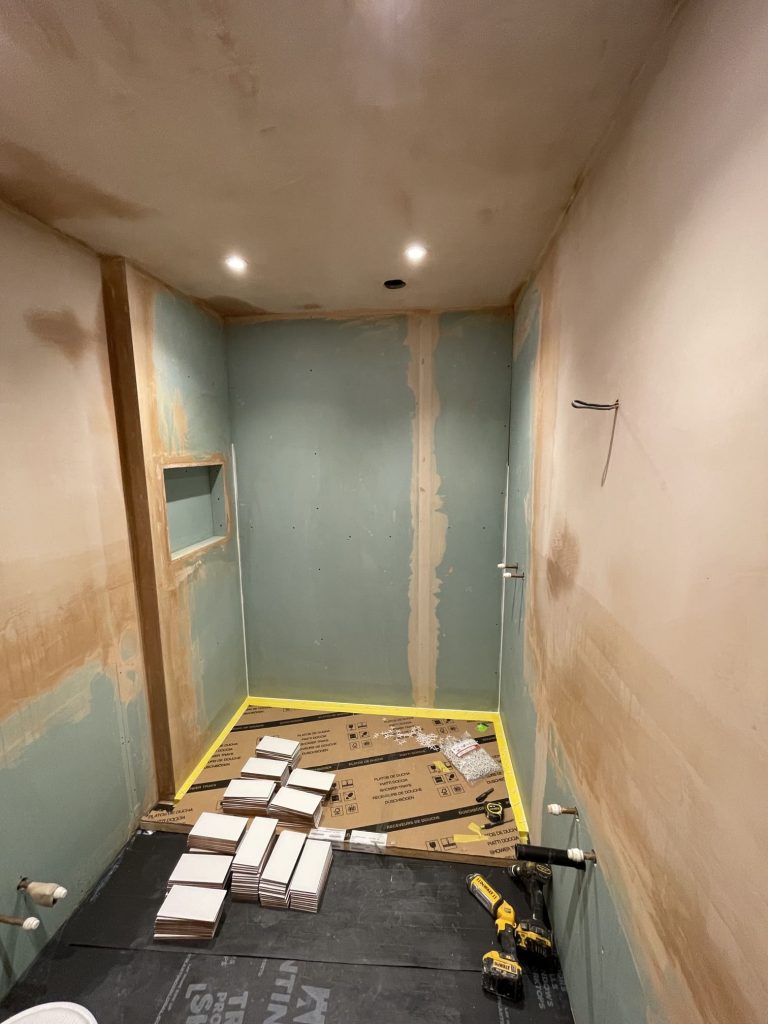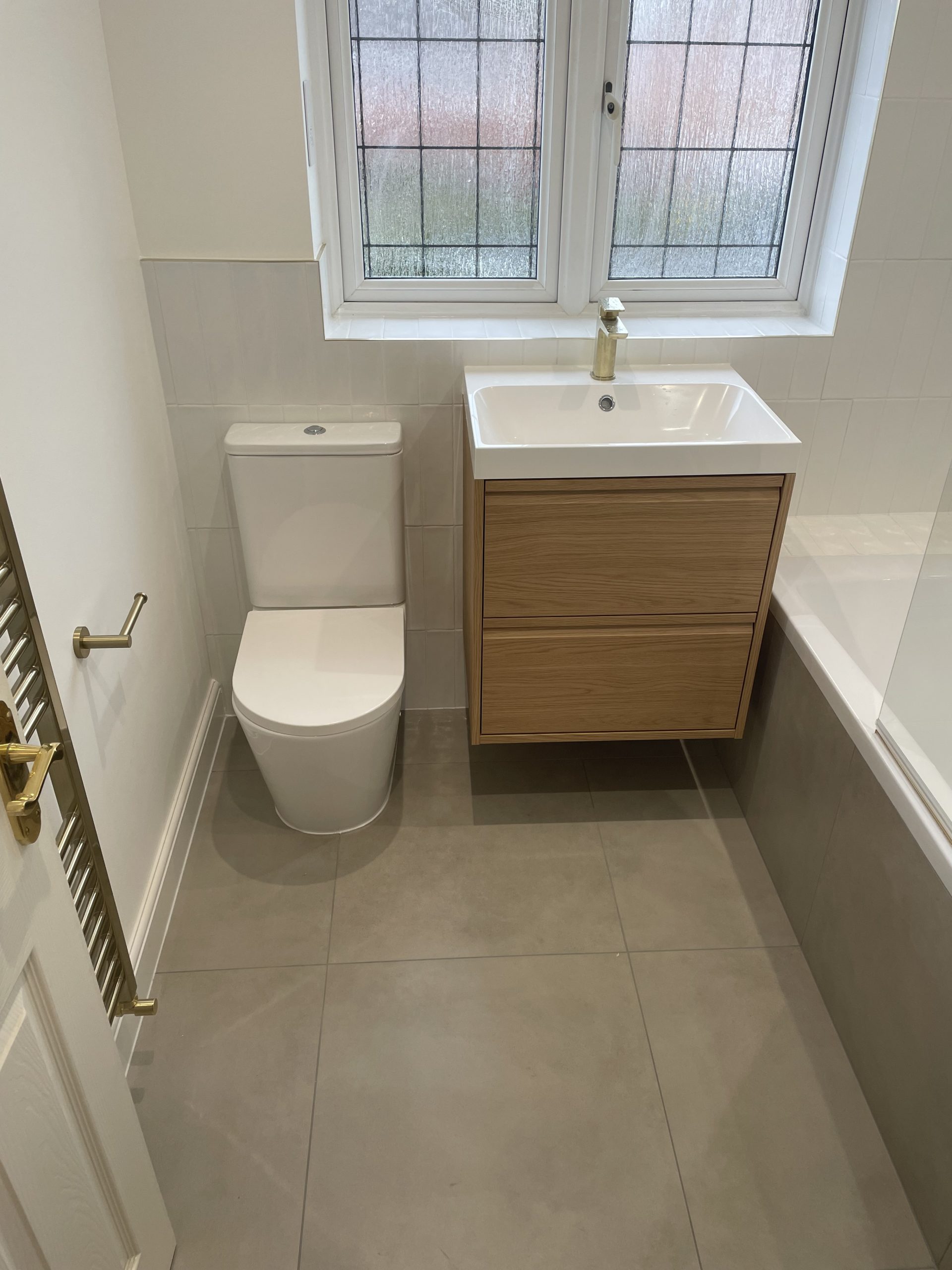
Most homeowners go into a bathroom renovation with one number in their head. The quote surprises them — not because it’s high, but because of how it breaks down.
After hundreds of bathroom refits across Reading and Berkshire, we find the same pattern every time: people expect materials to dominate the budget. In practice, labour and preparation work account for roughly half of the total bathroom renovation cost — sometimes more. Understanding that rebalances the entire conversation about what a 2026 refit in Reading actually costs, and where your money genuinely goes.
What Drives the Cost of a Bathroom Renovation in Reading
Labour, materials, and the work beneath the tiles
Labour typically represents 40–50% of a bathroom renovation budget in Berkshire. That figure sits above the UK national average, and demand for skilled trades — particularly plumbers and tilers — has kept local rates elevated through 2025 and into 2026.
Materials tier dramatically. Tile choice alone can shift total project cost by £2,000–£4,000 depending on format size, origin, and finish. Entry-level ceramic tiles for a standard bathroom can be sourced for £20–£35 per m²; large-format porcelain from leading European manufacturers sits closer to £60–£120 per m², with installation time increasing in proportion.
Reading’s hard water adds a layer most homeowners don’t anticipate. Limescale accelerates corrosion on chrome fittings and thermostatic valves, which is why we specify WRAS-approved fittings and recommend appropriate sealant treatments for shower screens and tap bodies in this area. Factoring in water-compatible products upfront is considerably cheaper than replacing corroded fittings three years into a refit.
Then there is the property factor. Victorian terraces in Caversham and West Reading, Edwardian semis in Tilehurst and Wokingham — older housing stock routinely reveals surprises once strip-out begins: joist proximity to waste pipes, original lead pipe runs, lath-and-plaster walls that need full re-boarding before tiling. These are not failures of planning. They are the reality of renovating homes built before modern standards existed.
2026 Price Ranges: What Reading Homeowners Are Spending
Entry-level refresh: from £4,000 to £8,000
At this level you are looking at a like-for-like suite swap: same layout, new WC, basin, and bath or shower tray, with a standard tiling package on the main wet areas. First-fix plumbing follows existing pipework runs. Electrics are checked and compliant but not significantly reconfigured.
This tier works well where the layout is sound and the substrate is in good condition. It does not account for full strip-out complexity, structural surprises, or significant rerouting of waste and supply pipes. It is not — despite what some online cost calculators suggest — a realistic budget for a full reconfiguration of an older Reading property.
Mid-range full refit: £8,000 to £15,000
This is where the majority of Reading homeowners land for a genuine full bathroom renovation. The scope typically covers complete strip-out and disposal, a quality suite, full tiling to walls and floor including wet area waterproofing, first and second-fix plumbing, Part P compliant electrics, and a walk-in shower conversion if the footprint allows.
At this level there is meaningful room for specification choices: walk-in shower enclosure versus frameless glass, semi-recessed basin versus wall-hung, porcelain versus ceramic floor tiles. These decisions shape both the end result and where the budget flexes.
Premium and bespoke bathrooms: £15,000 to £30,000+
Premium refits bring together large-format porcelain (600×1200mm or larger), freestanding baths, wall-hung sanitary ware on concealed cistern frames, full-floor waterproofing systems, and bespoke vanity or joinery elements. Smart thermostatic controls and feature lighting sit at this level too.
Labour here is specialist-intensive. Large-format tile laying on a perfectly level substrate, frameless glass installation, and concealed cistern frame setting are technically demanding. The difference in quality between experienced and inexperienced tradespeople is immediately — and permanently — visible in the finished result.
What the Cost Includes — and What Catches People Out
A detailed scope is the difference between a quote that holds and one that doesn’t. A properly specified Reading bathroom renovation should include:
- Strip-out and disposal — removing the existing suite, tiles, and wall boards, including skip hire
- Substrate preparation — boarding, levelling compounds, and structural repairs to walls or floors
- Tanking and waterproofing — a membrane system to shower areas and, for higher specifications, the full floor. We cover the waterproofing methods that underpin every refit we complete in depth separately
- First-fix plumbing — waste and supply pipe rerouting to the new layout
- Second-fix plumbing — connecting, seating, and commissioning all sanitaryware and fittings
- Tiling — floor and walls, including adhesive, grout, and silicone to all wet areas
- Part P electrical work — extractor fan, shaver socket, heated towel rail connections, underfloor heating thermostat if specified
- Fixture supply and installation, final commissioning and clean
What typically falls outside the standard scope: structural alterations to enlarge the space, damp investigation or mould remediation discovered during strip-out, and design fees if an external bathroom designer is engaged. For a full picture of what happens at each phase of a refit, what a professional bathroom installation involves at each stage walks through the process in detail.
How Long Does a Reading Bathroom Renovation Take?
Realistic timelines for 2026, based on projects across Reading and wider Berkshire:
- Entry-level suite swap: 5–8 working days
- Full mid-range refit: 10–15 working days
- Premium bespoke bathroom: 3–4 weeks
The most common cause of delay is tile delivery lead times. Large-format and specialist porcelain tiles are frequently ordered from European manufacturers with 2–4 week lead times, which is why we order all materials before work begins. A bathroom stripped and waiting for a delayed delivery is a disruption no one needs.
Older Reading properties introduce their own timeline variables: pipe routes that require rerouting through adjacent rooms, floor joists that need sistering before a heavy tiled floor can be laid. Addressing these properly adds days, not weeks — but skipping them shortens how long the finished bathroom performs.
Where Berkshire Homeowners Overspend — and Where Not to Cut Corners
Changing specification mid-project is the most expensive mistake we encounter. Switching from porcelain to natural stone halfway through can cascade into adhesive specification changes, additional sealing requirements, and extra preparation time. Agree your specification in full before work begins and hold to it.
Underinvesting in waterproofing is the other false economy. A correctly applied tanking membrane system — to walls and floor in wet areas before any tile goes down — is non-negotiable. Applying a budget liquid system too thinly, or skipping it entirely, compromises the whole installation. Water tracking into a floor structure or partition wall creates remediation costs that dwarf what the membrane would have cost. Which? recommends checking that any contractor includes tanking explicitly in their written specification, not just as a verbal assurance.
Where considered savings make sense: accessories (towel rails, mirrors, soap dispensers), non-wet-area wall tiles where a simpler format creates a cleaner result, and lighting pendants — all aesthetic choices without structural consequence.
Where quality specification always pays: thermostatic shower valves (budget units fail within two years in hard water areas), grout and silicone (visible joint failure is the first thing people notice in any bathroom), and extractor fan capacity (under-powered extraction in a well-used bathroom creates persistent condensation problems within months).
Our bathroom renovation service in Reading covers the full scope — design consultation, materials supply, and trade coordination from strip-out to final handover.
Frequently Asked Questions
How much does a full bathroom renovation cost in Reading in 2026?
A full bathroom refit in Reading typically ranges from £8,000 to £15,000 for a mid-range specification covering strip-out, new suite, full tiling, plumbing, and Part P electrics. Entry-level like-for-like swaps start from around £4,000; premium bespoke bathrooms with large-format porcelain and wall-hung sanitary ware run from £15,000 to £30,000 and above.
Does a new bathroom add value to a Reading property?
In most cases, yes. A well-specified bathroom renovation typically returns 50–70% of its cost in added property value, while also improving saleability. In high-demand Reading areas — Caversham, Earley, Sonning — a dated bathroom is a visible price reduction in a viewing. A professional refit removes that objection entirely.
Do I need Building Regulations approval for a bathroom renovation?
Most bathroom renovations are classed as permitted development and do not require planning permission. However, any electrical work must comply with Part P of the Building Regulations, and if you are moving soil stacks or drainage runs, a Building Regulations application to Reading Borough Council building control may be required. We advise on this at the initial consultation.
How long does a bathroom renovation take?
A standard full refit takes 10–15 working days. Entry-level suite swaps can be completed in under a week. Bespoke premium bathrooms with specialist materials and concealed cistern work typically run to 3–4 weeks. We order all materials before work begins to prevent tile delivery delays once strip-out is underway.
What is the most expensive part of a bathroom renovation?
Labour and tiling combined typically represent the largest portion of cost — often 55–65% of the total budget. The suite itself is frequently less expensive than homeowners expect. Specification decisions on tiles, shower enclosures, and thermostatic valves are where the cost range widens most significantly.
Should I upgrade the family bathroom or add an en-suite first?
For most Berkshire properties, upgrading the family bathroom delivers stronger ROI — it is the most-used space and the most visible to prospective buyers. An en-suite adds meaningful value specifically in four-bedroom-plus properties where buyers expect one. If budget allows only one project, the family bathroom is typically the stronger investment.
Can I use the bathroom during the renovation?
No — a bathroom under active renovation is not usable. For a standard 10–15 day refit, we confirm access to an alternative bathroom before agreeing a start date. It is a practical detail, but one worth planning for well in advance.