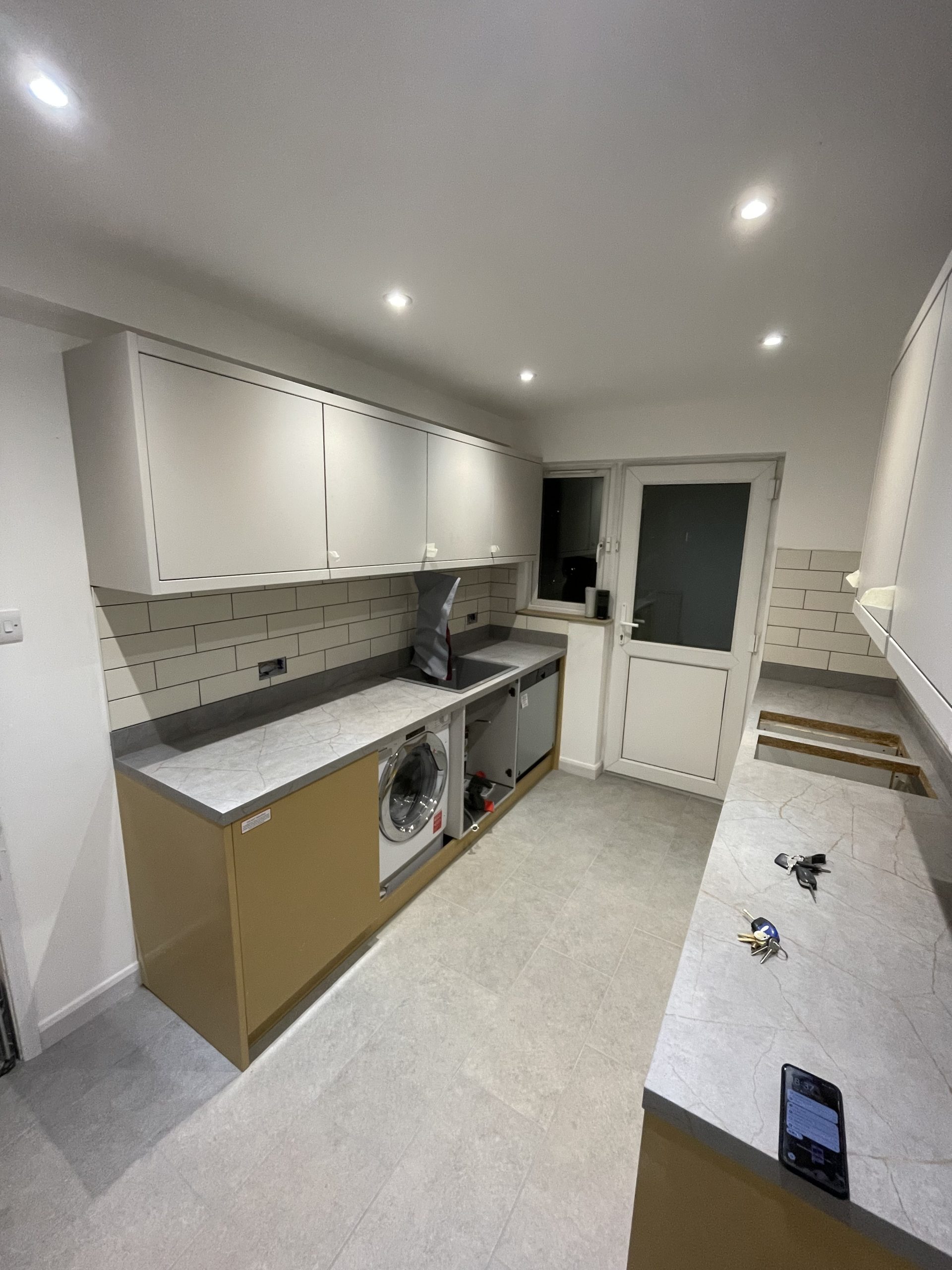
The kitchen island looked perfect in the showroom. Solid oak carcass, quartz top, built-in power sockets, enough overhang for three barstools. The homeowner measured twice. The fitters arrived on a Tuesday morning.
By Friday, it was clear the island would have to come out.
The walkway between the new unit and the existing run of base cabinets measured 68cm at the narrowest point – enough for one person standing still, not enough for a family of four running a normal Tuesday evening. The oven door, when fully open, left 11cm of clearance. The fridge door could not open without hitting the island corner.
This is not an unusual story. In ten-plus years and over 500 projects across Berkshire, we have seen more islands removed than most contractors will admit to fitting. The problem is almost never the island itself. It is the planning stage – specifically, the questions that were not asked before the decision was made.
Why Kitchen Islands Go Wrong Before a Single Tile Is Laid
The showroom sells the dream. It cannot sell the reality of your kitchen dimensions, your door swing geometry, your extraction requirements, or your household’s actual movement patterns through the room.
Kitchens in Reading’s Victorian and Edwardian housing present a particular challenge. Many of these properties were built when the kitchen was a working utility room, not a social hub. The footprint is functional at best – typically a rear addition or the back half of the original ground floor. Open-plan knock-throughs have given many of these rooms borrowed space, but that borrowed space comes with columns, chimney breasts, or awkward structural angles that a showroom floor plan cannot account for.
The island that works beautifully in a 4m x 5m open-plan kitchen in a new-build on Lower Earley often does not work in a 3.2m x 4.4m rear kitchen in a semi-detached Victorian terrace in Caversham. The geometry is different. The ceiling height, natural light source, and structural constraints are different. The solution has to be different too.
The Measurements That Actually Matter
There are three spatial thresholds that determine whether a kitchen island functions as part of a working kitchen or as an expensive obstruction.
The first is the minimum clearance on all sides. The standard used across professional kitchen design is 900mm (approximately 36 inches) of clear passage around each side of an island used for circulation only. For a working zone – somewhere a person will stand to prep or cook – 1,050mm is the practical minimum. Where seating overhangs on any side, you need a clear 1,200mm between the island edge and the nearest obstacle to pull a stool out without catching anything.
These numbers feel generous in a showroom. They shrink fast when you measure your actual kitchen and subtract the door swing from your dishwasher, fridge, and any built-in ovens.
The second threshold is the minimum island width. An island used purely as a prep surface can be as narrow as 600mm. One incorporating a hob, sink, or under-counter appliance needs to run to at least 900mm to allow the proper installation of services and maintain sufficient workspace on either side. Islands with seating overhangs typically run to 1,050mm or more on the worktop depth.
The third is extraction. A hob on an island requires either a ceiling-mounted extractor above it or a downdraft unit built into the worktop itself. Both carry implications – the ceiling route for your structure and plaster, the downdraft route for sub-floor access. In a property with original lath-and-plaster ceilings, routing a duct overhead requires more than hanging a canopy hood. It requires structural assessment and, often, re-plastering work across a wider area than the duct itself. Our professional kitchen installation process always includes a pre-fit survey specifically to surface these complications before any ordering happens.
How Reading’s Housing Stock Shapes the Decision
Reading’s period housing is one of the reasons what a full kitchen installation actually involves goes well beyond a visit to a showroom. The constraints vary by property era and street.
Victorian terraces in Newtown, West Reading, and Caversham typically have narrow rear kitchens running parallel to the party wall. Many have had extensions built over the rear yard, which creates a longer room but not necessarily a wider one. An island in this configuration usually needs to be oriented lengthways, parallel to the run of existing units, with deliberate clearances at both ends – and the structural condition of any rear extension floor should be checked before committing to a heavy stone or concrete worktop above it.
Edwardian semis in Tilehurst and Wokingham tend to have slightly more generous kitchen proportions – often a wider footprint and higher ceilings – but they almost always retain a chimney breast on the rear or side wall. That breast limits the linear run of cabinets and can make positioning an island feel non-obvious. We regularly survey these properties before any kitchen design is committed to paper, because the chimney breast position changes the usable floor area by more than photographs suggest.
1930s and 1950s houses in Earley and Woodley often present the cleanest proposition for an island: purpose-built kitchen layouts with enough room to breathe. Even here, the original layout was typically galley-style, a corridor of cabinets on two facing walls. Adding an island into that configuration means being clear-eyed about whether you are genuinely adding workspace or simply reducing floor area in a room that functioned well without one.
The Configuration Options Worth Considering
Where a full freestanding island is not workable, there are frequently configurations that achieve most of the same outcomes with a tighter footprint.
A peninsula unit – a run of cabinets projecting into the room from one wall rather than floating in the middle – delivers seating, prep space, and the visual connection between kitchen and living area that most island briefs are really asking for. It requires clearance on only three sides rather than four, which makes it viable in rooms where a floating island would feel squeezed. For kitchens under 4m wide, a peninsula is usually the more functional answer.
A freestanding prep unit is sometimes appropriate where the kitchen is used seriously for cooking rather than display. These units sacrifice built-in services and fixed seating but preserve the floor area when not in use – a meaningful advantage in a smaller Reading terrace where the kitchen doubles as a circulation route.
Where the space genuinely supports a full island, worktop material deserves a separate conversation from the cabinetry specification. Reading’s notably hard water – characteristic of the Thames Valley chalk aquifer – affects how different surface materials perform over time. A quartz surface handles limescale consistently well with minimal maintenance. Untreated marble and some composite options are more demanding in a hard water area. We covered which worktop material holds up in Reading’s hard water area in a separate piece, and the detail there is worth reviewing before committing to a surface specification.
What to Resolve Before Any Island Goes In
The checklist we work through before recommending or designing a kitchen island covers more than floor dimensions.
First, where are the existing services? Gas supply, electrical ring circuit, cold-water supply, and drainage are all relevant if the island will incorporate a hob, socket outlets, a sink, or a dishwasher. Moving or extending these services is feasible in most Reading and Berkshire properties, but it has implications for floor and wall access – particularly in properties with original suspended timber floors where the route beneath the boards is not always straightforward.
Second, how is the room used on a typical day? A household of two adults who cook together has completely different circulation requirements from a family of five using the kitchen for homework, packed lunches, and after-school traffic. Getting this wrong on paper means getting it wrong in the room.
Third, what is the programme for the wider kitchen fit-out? An island installed in isolation – added after the rest of the kitchen is complete – frequently runs into problems with floor finishing, kickboard alignment, and service access that are difficult to resolve neatly. Planning the island as part of the full kitchen specification from the outset produces a more consistent result.
At Reading Renovations, our kitchen projects begin with a site survey that maps existing services, identifies structural constraints, and produces a floor plan drawn to the actual room dimensions – not a showroom estimate. It takes the time upfront that saves the more disruptive return visits later.
Frequently Asked Questions
What is the minimum kitchen size to fit an island in Reading?
As a working guide, a kitchen needs to be at least 3.6m wide to accommodate an island with 900mm clearance on both sides and a 900mm minimum island width. In practice, we rarely recommend an island in a room narrower than 4m, because 3.6m leaves no margin for appliance door swings and becomes uncomfortable in daily use.
Can I add a kitchen island to a Victorian terrace in Reading?
Yes, but it requires a specific survey of the room. Victorian rear kitchens in Reading are often long and narrow rather than square. The more useful question is usually whether a peninsula unit or a freestanding prep station achieves the same brief in the available space – and that is best assessed on-site rather than from a floor plan.
Do I need Building Regulations approval for a kitchen island?
A fitted island that does not involve gas or drainage work typically falls outside the scope of a Building Regulations application. If you are moving a gas supply or adding a sink with drainage to the island, the relevant Part G and Part J notifiable works apply. The Planning Portal provides guidance on what kitchen works require formal notification. Our team coordinates the appropriate submissions as part of the project.
How long does fitting a kitchen island take?
A standalone island installation as part of a full kitchen fit-out typically adds one to two working days to the overall programme. A more complex specification involving a hob, extraction ductwork, and electrical additions could extend this by two to three further days, depending on ceiling access and floor construction.
What should I look for in a kitchen island worktop in a hard water area?
In the Thames Valley, material choice matters more than in soft-water regions. Quartz performs well with minimal upkeep. Granite is durable but requires periodic sealing to remain stain-resistant. Composite surfaces vary significantly by product. Our worktop guide covers the practical differences for Reading and Berkshire conditions in more detail.
Is an island suitable after an open-plan knock-through in a Berkshire semi?
A knock-through creates the square footage but does not guarantee the column-free span that makes an island work cleanly. A steel post or RSJ from the original structural opening can limit where an island can comfortably sit. A site survey before committing to any layout is the sensible first step.
Can a kitchen island serve as the main dining area?
An island with a seating overhang works well as a casual dining space for two to three people. As the primary dining solution for a larger household, it tends to feel cramped – the seating typically runs along one side only, which suits a quick breakfast but not an extended family dinner. Most of our clients who specify island seating retain a separate dining table alongside.
Thinking about a kitchen island for your Reading or Berkshire home? Get in touch via our free consultation form – bring your floor plan, we will bring the measurements, options, and an honest assessment of what will actually work in your space.