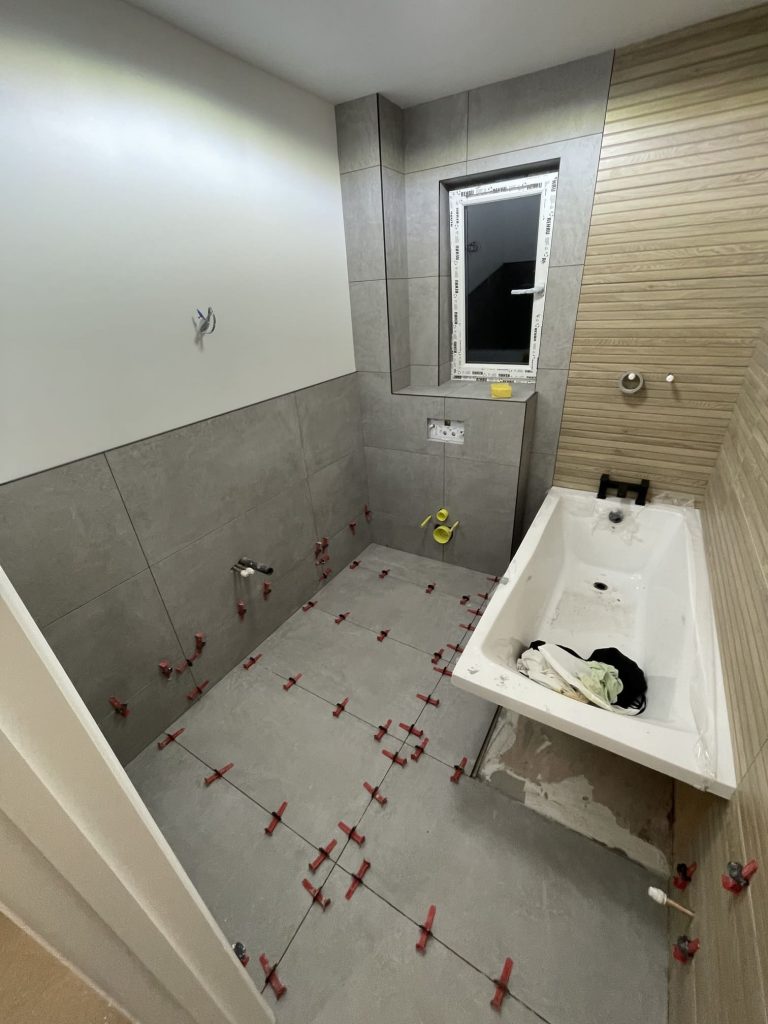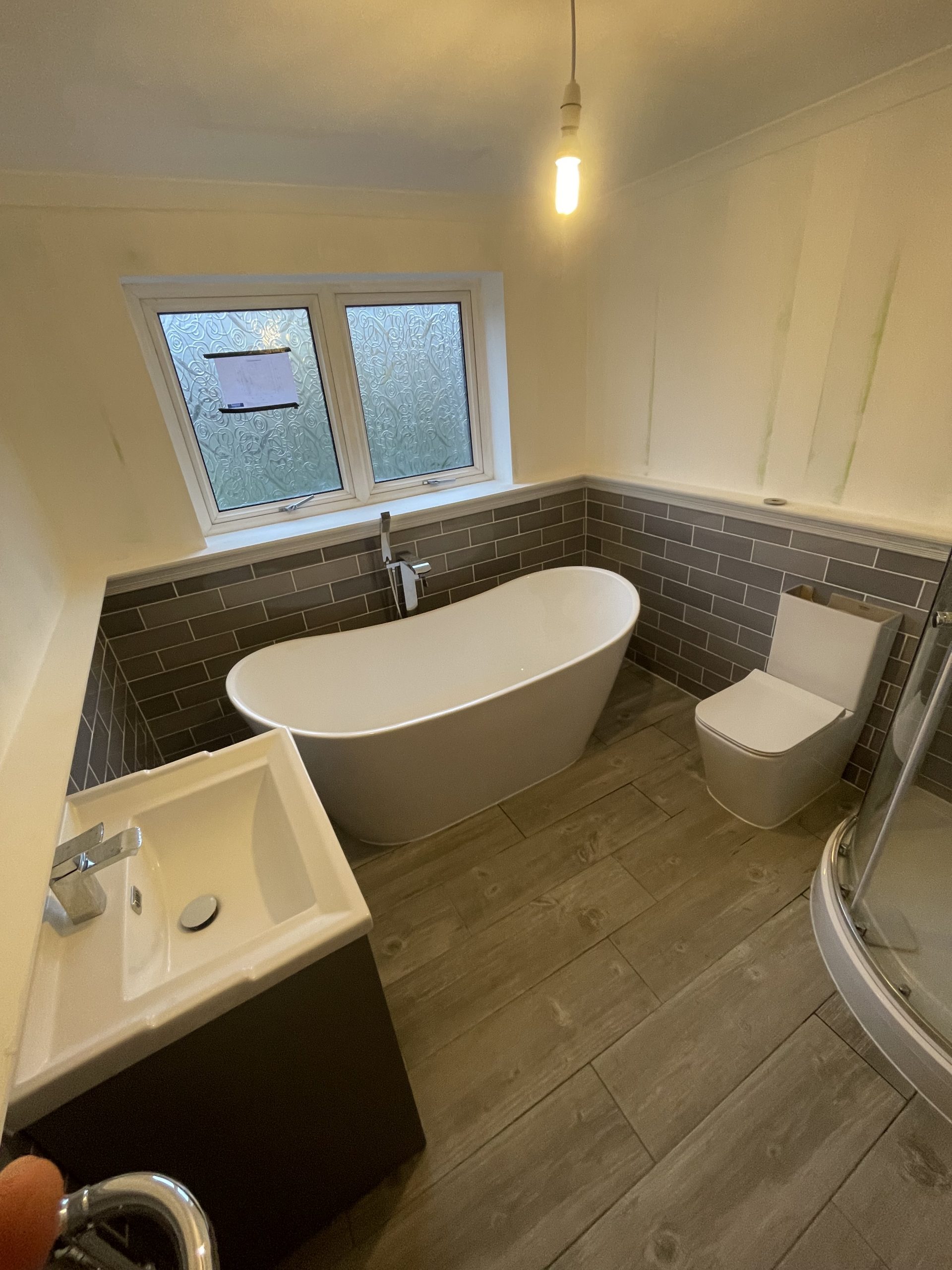
Most homeowners planning an en-suite bathroom in Reading focus on the tiles and suite selection. The real complexity is almost always behind the walls – in the plumbing routes, the partition construction, and the ventilation strategy that determines whether the room performs as intended ten years from now.
After 500+ projects across Berkshire, our team at Reading Renovations finds that the en-suite conversation almost always follows the same arc. Early on, everything centres on style: walk-in shower or bath, heated towel rail, which basin format. Then, once we are on site and talking about first fix, the questions shift. Where does the soil pipe run? How thick does the partition need to be? What does Building Regulations say about a bathroom with no external window?
Understanding what the work actually involves – before committing to a layout – is what separates a smooth installation from a project that drags or ends in compromise.
The Space Question: Minimum Dimensions and What Reading Properties Allow
The practical minimum for a functional shower en-suite sits around 1,800mm x 1,800mm (roughly 3.2 sq m). That gives you a single shower enclosure, a wall-hung basin, and a close-coupled WC with reasonable circulation space. Below that threshold, the room either stops functioning properly or demands unusually precise product choices.
What matters in Reading and wider Berkshire is that minimum theory and property reality often diverge. Victorian terraces in Caversham and West Reading typically have solid brick party walls and limited spare floor area. The conventional approach of taking a metre off the end of a bedroom works on a 4.5m room. On a 3.6m room, it can leave both the bedroom and the new en-suite feeling compressed.
The options worth exploring:
- Borrowing space from a landing cupboard or airing cupboard (surprisingly common in Edwardian semis across Wokingham and Tilehurst)
- Reconfiguring an adjacent doorway to realign available floor area
- Using a wet room configuration where a shower enclosure would eat a disproportionate amount of space
That last option is a genuine alternative, not a fallback – provided the tanking and drainage are correctly specified. We covered the differences in detail in our piece on wet room installation in Reading.
Plumbing First Fix: Where the Real Work Happens
First fix is the phase most clients never see and frequently underestimate. For an en-suite, it means running hot and cold supply pipes to the new room, installing a soil and vent pipe run to serve the WC, and positioning waste outlets for the shower and basin before any boarding or tiling begins.
The routing of the soil pipe is usually the most consequential decision. In a two-storey property, the soil pipe typically needs to connect to an existing stack – meaning it runs through the void above a ground floor ceiling or externally down an outside wall. In a Victorian terrace, that external run can conflict with roof geometry or the neighbouring party wall position.
Our plumbers assess this before we finalise any layout. A WC positioned on the wrong wall can require a 4-5m horizontal waste run, which creates gradient problems and potential for blockages over time. Getting it right at first fix stage costs nothing extra. Correcting it after the walls are tiled is a far more involved job.
Supply runs for both the shower valve and the basin are generally simpler, though hard water in the Thames Valley means we recommend isolating valves at every new outlet. It simplifies future maintenance and protects shower heads and cartridges from mineral build-up – a practical consideration specific to this part of Berkshire.
Ventilation: What Building Regulations Actually Require
Bathrooms without an openable external window – which describes the majority of en-suites, given their internal position within a bedroom – are subject to specific requirements under Building Regulations Part F. The requirement is mechanical extract ventilation at a minimum rate of 15 litres per second for an intermittent fan, or a lower continuous rate with boost capability.
In practice, this means a ducted extractor fan connected to an external vent – either through an outside wall or via a roof duct. The routing needs planning at first fix stage, not as an afterthought once walls are boarded.
Two things catch people out. First, duct length and number of bends affect fan performance significantly – a unit rated at 15 l/s in free air can fall below the legal minimum through a long, restricted duct run. Second, a basic timer-controlled fan is not the same as a humidity-sensing unit. In a well-insulated property, a timer can leave residual moisture that accumulates over months. We generally specify humidity-sensing fans in new en-suite installations as a straightforward quality upgrade.
Building Control sign-off is required where the work involves structural elements – for example, where a partition connects to a load-bearing wall, or where an en-suite in a loft involves alterations to the roof structure. A straightforward new partition in an existing bedroom typically falls under the competent person scheme via your registered plumber and electrician.
What Period Properties in Reading Demand
Reading’s Victorian and Edwardian housing stock presents specific conditions for this kind of work. Solid brick walls mean that supply pipes and waste runs cannot be chased and concealed as easily as in a modern stud-framed property. Pipes tend to run within new stud partitions built off the existing masonry, which adds some thickness to the finished room but keeps the original walls undisturbed.
Original suspended timber floors also create complexity. Running a waste pipe through a floor void is standard practice, but older joists may have existing notches or drillings from decades of previous plumbing and electrical work. Our team always surveys the void before finalising waste routes – a joist that has been over-notched is a structural concern, not just a plumbing one.
Damp proof courses in pre-1920 properties are sometimes absent or degraded. For an en-suite positioned over a solid ground floor – less common but it does occur in rear bedroom additions and converted outbuildings – we check substrate moisture levels before specifying the waterproofing membrane. The survey findings then directly inform our waterproofing specification, screed depth, and tile substrate choice for the room.
Our approach to bathroom renovations in Reading in period properties always starts with understanding what is behind and beneath – the fabric of the building shapes every decision that follows.
En-Suite vs Wet Room vs Shower Room: A Practical Distinction
These terms are often used interchangeably but they describe meaningfully different rooms.
An en-suite is a bathroom directly accessible from a bedroom, without passing through a shared space. It can contain any combination of shower, bath, basin, and WC. The defining characteristic is private access, not the room’s internal configuration.
A wet room describes a room where the shower area has no enclosure – water runs across the entire floor to a central or linear drain, requiring full-floor tanking to a higher specification than a conventional tray installation.
A shower room contains a shower rather than a bath but is otherwise configured as a standard bathroom. It may or may not be en-suite.
The distinction matters in specification. A client who describes wanting a wet room en-suite is describing a room requiring full-floor tanking, a linear drain, and a floor fall across the entire surface – a considerably more involved waterproofing job than a tray-and-enclosure shower. The tanking approach and waterproofing specification differs in each case, and it affects the screed, the tile selection, and the installation sequence from day one.
Frequently Asked Questions
Do I need planning permission to add an en-suite in Reading?
Planning permission is not required for an internal en-suite that does not affect the external appearance of the building. Building Regulations approval is required where the work involves structural elements (alterations to load-bearing walls or floor joists), new electrical circuits, or mechanical ventilation. Your contractor and trades should be registered under relevant competent person schemes, or you can apply directly to Reading Borough Council Building Control.
How long does an en-suite installation typically take?
A straightforward en-suite in an existing bedroom – stud partition, plumbing first fix, boarding, waterproofing, tiling, and second fix – typically runs three to four weeks. More complex projects involving structural survey, soil pipe routing through external walls, or suspended floor repairs add time. We confirm a realistic programme after the first site visit.
Can adding an en-suite increase the value of a Reading property?
In the mid-to-upper end of the Reading and Berkshire market – Caversham, Earley, Wokingham, Sonning – a properly specified en-suite to the master bedroom is treated as a standard feature by buyers. Poorly executed en-suites, particularly those with inadequate ventilation or damp problems, can work against a sale. Specification and workmanship quality matter more than the mere presence of the room.
What is the minimum size for a functional en-suite shower room?
A workable shower en-suite can be achieved in approximately 1,800mm x 1,800mm (3.24 sq m), accommodating a 900mm square shower enclosure, a compact wall-hung basin, and a close-coupled WC. Below this, a wet room configuration – no enclosure, full floor drain – can work in 1,500mm x 1,800mm, provided tanking and drainage are correctly specified for the reduced footprint.
What does first fix involve and why does it take time?
First fix covers all the infrastructure installed before walls are boarded: hot and cold supply pipes, waste runs, soil pipe connections, electrical cabling for lighting, fan, heated towel rail, and shaver socket. It is the most technically demanding phase because errors here are difficult and expensive to correct after walls are finished. A thorough first fix, done once and correctly, is what gives an en-suite a long service life.
Will installing an en-suite reduce my bedroom size significantly?
That depends on the available floor area and which wall the partition takes space from. Our approach is to assess the bedroom floor plan before committing to a layout – sometimes borrowing space from an adjacent cupboard or landing void is feasible, or reconfiguring the bedroom entrance allows the en-suite to sit differently. We do not finalise dimensions until we have assessed the room in person.
Do you install en-suites in Victorian and Edwardian properties across Berkshire?
Yes – period properties account for a significant proportion of our en-suite work across Reading, Caversham, Wokingham, and Tilehurst. Solid brick walls, suspended timber floors, and older drainage arrangements create specific conditions that differ from modern construction. We carry out a fabric assessment before first fix to understand what is behind the walls and beneath the floor, and plan the installation accordingly.
Thinking about adding an en-suite to your Reading or Berkshire home? A free home visit tells you exactly what is feasible – we assess the available space, trace the plumbing routes, and give you a realistic picture of what the work involves. Book one via our free consultation form or ring 07999 083028.